Originality
Wikipedia tell us that, "Originality is the aspect of created or invented works that distinguish them from reproductions, clones, forgeries, or substantially derivative works..
I once was a printmaker. I was a member of a co-op studio named Malaspina Printmakers after graduating from Art School. I mastered litho and intaglio and woodcuts and screen prints. For years I made my living printing for other artists. I was very fit then. I literally could not do the work now. Printmakers made editions of identical prints. We were proud of our ability to make identical prints.
Printmakers had a problem. Most people figured that the identical prints were copies like copies from a printing press or photocopier. No No No printmakers would say. These are Original Prints. The idea was that the final image on paper was not a copy of the image on the printing matrix.
At the very least the printed image was a mirror image of the printing plate. Often many plates carrying different colors would be used. The actual printed image was not a copy of anything. It was Original.
I could see the idea but never thought it was very coherent, but the art market was oriented around editions of numbered Original Prints. There was a definite emphasis on rarity.
As well as being a fine art printer I had 20 years experience in the commercial printing industry. I mastered the whole tech from typesetting to platemaking to running a press and bindery. I had the idea that if an artist prepared plates for a printing press then the prints would be Original in the same way as if the artist did the printing or hired a printer.
This would be corrosive to the idea of scarcity. I pointed out the success of recorded music that was cheaply available. And people would buy it in vast quantities.
Robert Bateman actually was quite successful with that idea. He made fabulous realistic pictures of wildlife. And he put his plates on a big printing press in Florida IIRC. He'd go through a proofing process until the print was to his liking - Just like I would when I made prints - and then he'd say print it. He'd do editions of thousands of prints that were so popular that eventually they sold for high prices and he made a fortune to support environmental causes.
If one mentioned Bateman at Malaspina people would almost make the sign of the cross to ward off the devil.
The art world values scarcity. When I went to the Louvre long ago I was surprised to see art students with easels copying paintings. The copies I saw were excellent. I could see that copying was a great way of mastering the skill of painting. But everyone knew that the copies were worth next to nothing compared to the original.
I am like hmmmmm . . . at that.
A kind of over-riding myth in the art world is that art is about beauty and aesthetics. I used to like browsing in poster stores in a mall more than galleries in our local gallery row. The posters offered all kinds of aesthetic experiences that you could buy for $20. But the art world sniffs - those things are reproductions - not art. The obvious implication is that "art" is a social construct that has little to do with aesthetics.
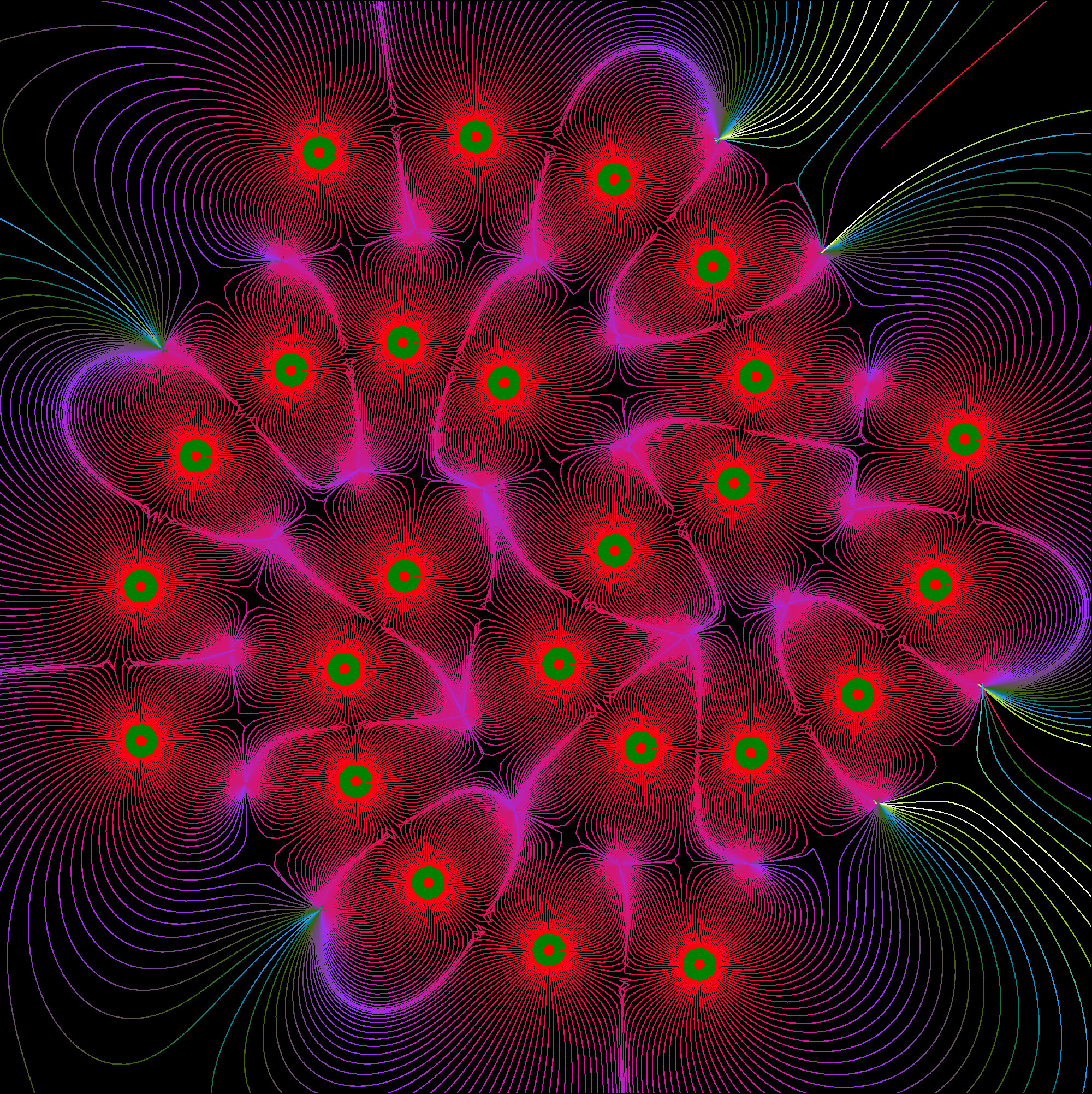
For the last 15 years or so (time flies) I've been using a method of making pictures that create a supersymmetric image that I call a snowflake. The method involves making symmetric triangles that you can copy and rotate to fill a circle like the wedges in a pie. The name snowflake comes from the first few of these I made had complex hexagonal symmetry like snowflakes do because I was using an equilateral triangle as the wedge shape.
I can do the same thing with 3,4,5,6,7,8,9, 10, and 12 sided regular polygons.
This method of making pictures is very productive. For a while I was getting 6x8 inch paper prints but had to stop when the stack got to be a foot high. That was years ago. Since then I've been filling hard-drives with pictures. The Snowflake Method can produce interesting images from just about anything. And they are all unique. Are they original?
With frozen snowflakes one finds that though they are all unique after a while they become 'same ol same ol'. That can easily happen with the Snowflake Method. I'm sort of surprised that the Method has kept me interested for so long but I'm always finding new ways of working with it. The pictures I make now are very different from the ones in my stack of prints. In a way the idea of originality is irrelevant for my work. For me my collection is the result of a long exploration.
I read recently that students who used AI to help them write were measurably worse at presenting original ideas - as in ideas that came from their own exploration - but the AI assistance produced essays that seemed way more erudite. This makes sense in the context of originality being the product of an exploration - exploration takes practice and if you don't practice you never get out of a small box.
What do you think?
 I present regular philosophy discussions in a virtual reality called Second Life.
I set a topic and people come as avatars and sit around a virtual table to discuss it.
Each week I write a short essay to set the topic.
I show a selection of them here.
I present regular philosophy discussions in a virtual reality called Second Life.
I set a topic and people come as avatars and sit around a virtual table to discuss it.
Each week I write a short essay to set the topic.
I show a selection of them here.